
I grow my tomatoes at home. They are very easy to grow and make an excellent choice for those just starting out with a vegetable patch. They are wonderful eaten fresh, but are also a key ingredient when making meals from scratch. Just think of all those cans and/or jars of diced tomatoes, whole tomatoes and pasta sauce you have picked up at the grocery store over the years.
What if you could not only grow your own but also preserve them, eliminating the need to purchase cans and jars and saving money and the environment? Preserving your tomatoes is easy, and I always have plenty of jars of organically grown tomatoes on hand to reach for whenever I am cooking. If you don’t have enough in your garden, you can pick up great deals at the local farmer’s markets when tomatoes are in season.

So here we go.
First, wash the tomatoes and remove any stalks. Roughly chop and place them into a large pot.

Place them on the stove on high heat and cook. Tomatoes are mostly water, so a lot of liquid will come out of them as they begin to cook through.
Bring the mixture to a boil, then stir well. Cook for about 10 minutes. There is no need to cook for a long time. You want to cook the tomatoes long enough to release all their juices.

In the meantime, prepare your jars. I use recycled jars from friends and neighbours. I picked up this bunch just the other day when I visited my neighbour Marion for a cup of tea and a catch-up. She knows I am always looking for jars, so she saves them for me. Ask your neighbours; I am sure they would love to help you out. Don’t know your neighbours? Here’s your chance to fix that. Remember, we are all in this together.
Using these free jars for my homegrown tomatoes will fill my pantry and keep these jars out of landfill. For preserving tomatoes, I use 500 ml jars.

Wash your jars in hot, soapy water, then rinse in hot water. While the jars are still hot, fill them with the hot tomatoes using a jar funnel and a ladle. Leave a headspace of 25mm.
For every 500 ml jar of cooked tomato, add 1/4 teaspoon of citric acid. This will ensure the pH is below 4.6, making it safe to use a boiling water bath to preserve the tomato for later cooking.
Tomatoes must be processed in a boiling water bath or pressure canner. Which method is used depends on the food’s pH. Tomatoes are borderline at the 4.6 cut-off between high-acid and low-acid, so if you are going to use the boiling water bath method, as I do, you will need to increase the acid. THIS IS IMPORTANT FOR FOOD SAFETY.
Once the jars have been filled, wipe off the rim. Using new lids, close the jars and tighten the lids.

Process the filled jars in the boiling water bath for 35 minutes. Check out my blog post on boiling water bath if you need a refresher on this method.
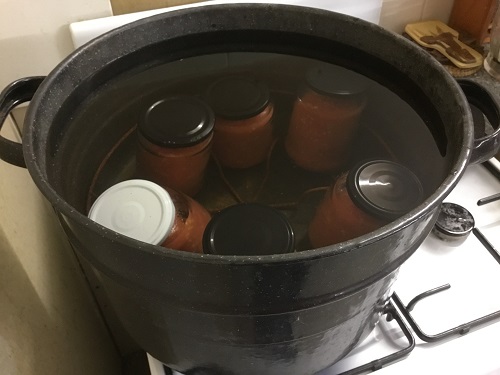
Once the 35 minutes are up, remove the jars from the boiling water bath using a jar lifter and set the jars on a tea towel on your kitchen counter to cool.

Once they have cooled down, the safety pop top will pop down, ensuring a complete seal. Label the jars and put them into your pantry.
Now you have jars and jars of tomatoes just waiting for you to create a fantastic pasta sauce, add to a stew, or…… well, you get the idea. Time to get creative in the kitchen, save some money and gain some independence, all at the same time.
As always, live well.
Valerie